
Seven Years of Publishing on Steam
Somewhere around the middle of 2014 I was looking at a folder of finished games that nobody could buy any more. Casual portals were dying, the mobile stores need constant push, and these were games people had actually paid money for not that long before. So I did opened a Steamworks account, mostly to see what would happen. Yet Steam said it will collect 30% tax from Ukrainian publisher without any negotiations. So I googled the articles on incorporating in the US.
What happened is that seven years later there are eighteen games on it, six DLC packs, one demo, and a small pile of paperwork that lives in Las Vegas.
The totals, since I find other people’s posts about this annoyingly vague: 274,091 units through Steam, 73,523 retail activations, 347,614 copies altogether. I will not be posting the revenue, sorry.
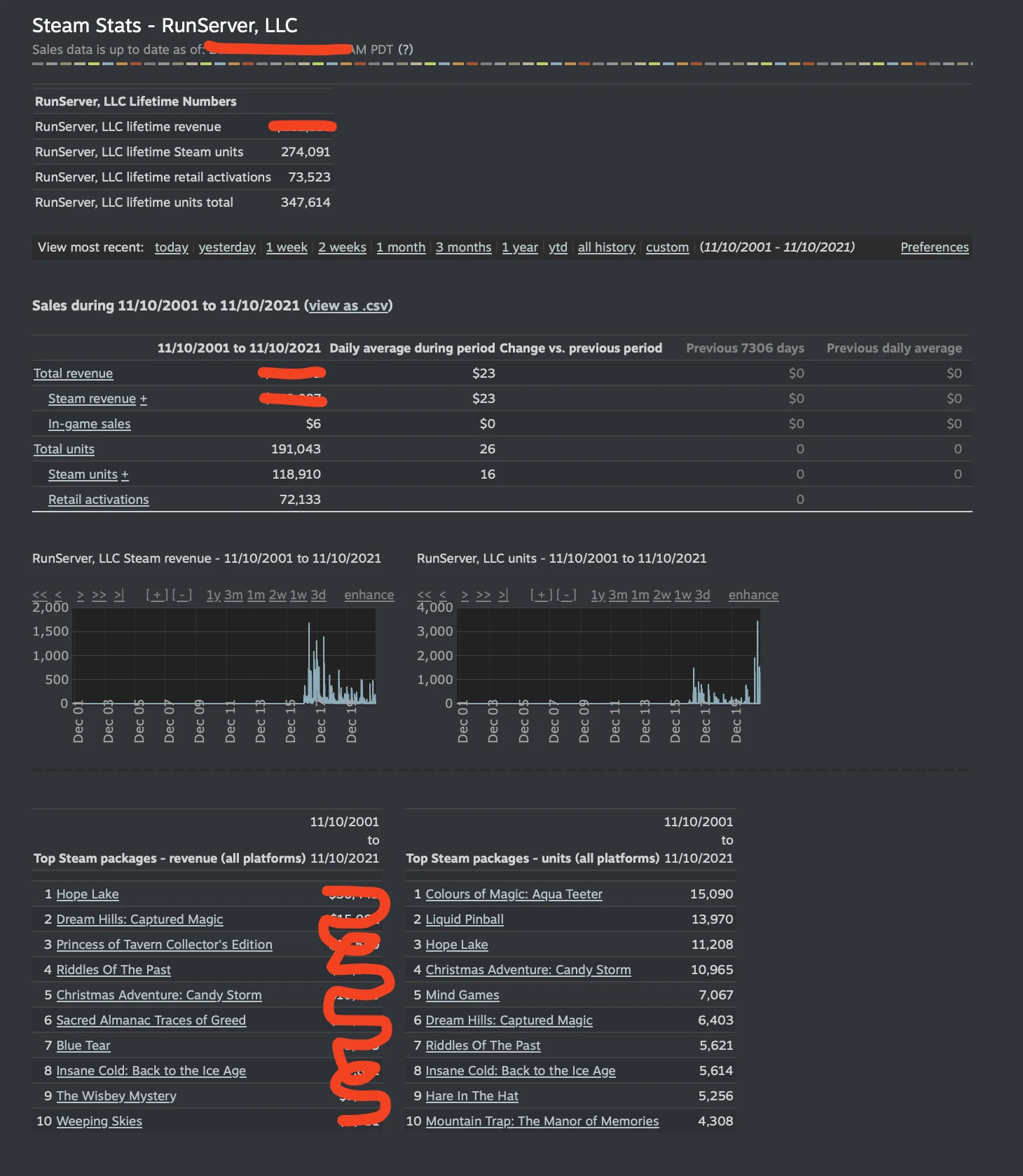
The unit ranking still surprises me. Colours of Magic: Aqua Teeter is top at 15,090, Liquid Pinball second at 13,970, then Hope Lake, then Christmas Adventure: Candy Storm, then Mind Games at 7,067. Order it by revenue instead and the list rearranges itself almost completely. Cheap games sell copies, and I knew that in the abstract, but there is something clarifying about watching your best seller sit halfway down the money column.
The Business
The increase in income was sweet, and having a legal facade was an opportunity, so I started looking for other developers with offers – they are to keep 70 to 85 percent, we take the rest and, in exchange, they never have to open Steamworks.
That sounds like a small thing if you have never had to do it. Store pages, builds, depots, regional pricing, age ratings, the discount submission that has to go in weeks before the sale it is for. I have met more than one developer who missed the Autumn Sale entirely because nobody warned them about that last one, and once you have missed it you get to think about it until the winter.
The rest is promotion, which for us means our own community rather than press releases. Giveaways, bundles, the seasonal events, every major sale of the year. It is not glamorous. It works about as well as you would expect for a catalogue of hidden object games and puzzlers, which is to say: modestly, but consistently, and for years after release.
The people
So now publish for FarMill Games, a Ukrainian studio; for EvoBucks, a Canadian publisher; and for four independent developers.
About the Ukrainian teams: they are the best I have worked with. They argue with you when you are wrong, and they deliver. Whatever this business has been worth to me, that part has been worth more.

My own back catalogue
The other half of the account is mine, republished under RunServer: Hare In The Hat, Siege Wars, Mind Games, Liquid Pinball, and so on. Several of them originally shipped for hardware that no longer exists. Getting them onto Steam meant new resolutions, new store art, and in at least one case rewriting a rendering path (OpenGL ES 1.0 -> Open GL 4.3).
Liquid Pinball has now sold 13,970 copies on a platform it was never designed for. I try not to think too hard about what that says about the time I spent on the original version.
Would I recommend it
If you are a developer: probably, assuming you would rather be writing code than reading Valve’s documentation, and assuming you are comfortable with somebody else holding the store relationship. Ask for the split in writing.
If you are thinking of becoming a publisher: think about it a while longer. The margin on casual games is thin, most of the work is administrative, and the single thing that decides whether a title earns anything, which is whether the game is any good, was settled long before it got to you. You are not going to fix a weak game with a bundle placement.
What has kept me at it is duller than a business case. Games I finished a decade ago are still selling, in small numbers, month after month, and the people who made them are still getting paid. After the number of projects that simply stop existing, that turns out to be worth quite a lot to me.