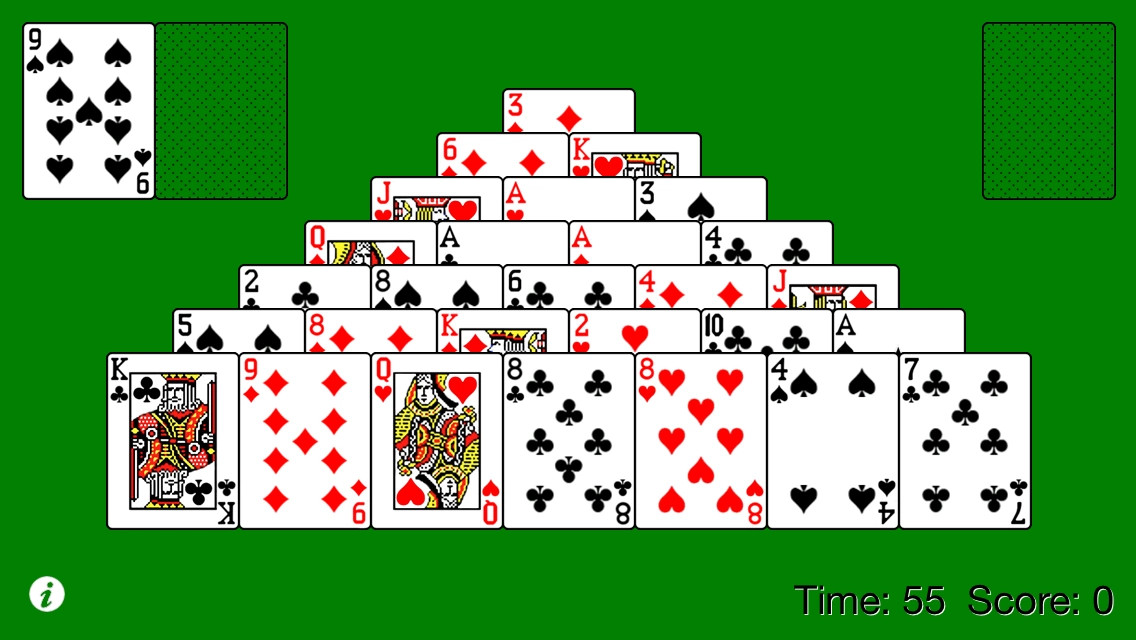
Klondike is about sequences. FreeCell is about finding a path through a fully visible board. Pyramid solitaire asks for neither. You are staring at a triangle of cards and doing arithmetic: find two exposed cards that add up to thirteen, and take them off the table. That is almost the entire rule set, and it produces a game that feels nothing like either of its better-known cousins.
How the Pyramid Is Built
The deal uses 28 cards arranged in seven overlapping rows, one card in the top row, two in the next, three in the next, and so on down to seven cards across the bottom. Each card in an upper row rests on top of two cards beneath it. The remaining 24 cards sit off to the side as a stock, which you turn over one at a time into a waste pile.
A card is available to play only when it is not covered by anything. At the start of the deal, that means the bottom row is entirely open, since nothing sits below it. Every other card in the pyramid stays locked until both of the cards resting on it are gone. This is the mechanic that makes Pyramid feel like a puzzle rather than a race: you are looking past the valid pair in front of you, working out which pair unlocks the most useful cards next.
Clearing Pairs to Thirteen
Aces count as one, jacks as eleven, and queens as twelve. Any two exposed cards whose values add up to thirteen can be removed together, whether they sit in the pyramid, on top of the waste pile, or one of each. Kings are worth thirteen on their own, so a king is removed by itself the moment it is exposed, no partner needed.
You can pair cards from anywhere as long as both are currently uncovered: two pyramid cards, a pyramid card with the top of the waste pile, or, in some rule sets, the top waste card with the top stock card before it is even turned. The stock only gets turned over card by card, and most versions of Pyramid give you one pass through it, occasionally with a single redeal. That scarcity is what separates Pyramid from a game like Klondike, where you can often cycle the stock repeatedly and grind out a solution. Here, once a useful card is buried under waste you cannot reach, it may simply be gone for the rest of the hand.
A Murkier History Than Klondike's
Klondike and FreeCell both have reasonably well-documented paths into popular culture, FreeCell in particular through Paul Alfille's early computerized version and its long run bundled with Windows. Pyramid's origins are harder to pin down. It belongs to a broad family of patience games built around numeric matching rather than suit sequences, and card game historians have not settled on a single inventor or a clean date the way they have with some other variants. Treat any specific origin story you find online with some skepticism; the honest answer is that the game predates reliable record-keeping for it.
What is easier to say is how it reached the audience that plays it today. Pyramid became a fixture of digital solitaire collections alongside Klondike, Spider, FreeCell, and TriPeaks, and it is one of the games included in Microsoft's Solitaire Collection. That gave a comparatively obscure paper-and-cards game a second life as one of the default solitaire variants millions of people have at least tried, even if far fewer stick with it the way they stick with Klondike.
Why It Feels Different to Play
A round of Pyramid is short. There is no long tableau to work through and no foundation piles slowly filling up over ten minutes; either the pairs come together in a couple of minutes or the deal locks up and you are done. That brevity changes how losing feels. In Klondike, a loss usually means you ran out of moves after a long, visible effort. In Pyramid, you can lose in under a minute because the two cards you needed most were sitting on top of each other from the very first deal, and no sequence of decisions was ever going to free them both in time.
That is the core of the luck-versus-skill argument that follows this game around. Because so much of Pyramid depends on which cards happen to cover which other cards, and because the stock only gives you one real look at most of the deck, a meaningful share of deals are unsolvable no matter how well you play them. Good players lose constantly, not occasionally, and that is normal for this game in a way it is not for Klondike or FreeCell. The skill in Pyramid is less about finding the one correct path and more about not wasting the paths the deal actually gives you.
Playing It Well
Given how much the deal controls the outcome, strategy in Pyramid is mostly about avoiding self-inflicted losses rather than forcing a win out of a bad hand.
- Clear kings the instant they are exposed. They cost nothing and only ever help by opening the row beneath them.
- Before taking a pair, check what removing those two cards exposes underneath. A pair that unlocks two new playable cards is worth more than one that unlocks none.
- Keep a rough count of which ranks you still need. If you have already used three of the four sevens, the fourth becomes a card worth protecting rather than pairing off carelessly.
- Do not rush the waste pile. Once a card passes into the waste and gets buried by the next draw, it is effectively locked away for the rest of the hand in most rule sets.
- Favor pairs deeper in the pyramid over easy pairs sitting in the open waste, since the buried cards are the ones actually gating your progress.
None of this guarantees a win, and that is worth accepting up front rather than fighting. A losing streak in Pyramid is not necessarily a sign you are playing badly; it can just mean the last dozen deals were bad ones.
Playing It on a Phone
Pyramid suits short sessions better than most solitaire variants, which makes it a natural fit for a phone screen: a round takes a minute or two, and there is no penalty for stopping after a loss and starting fresh. On this site the game is available as Classic Pyramid for iOS, Android, and Windows, built around the same rules described here, no timers or forced redraws layered on top.
If you have mostly played Klondike or FreeCell, Pyramid is worth trying specifically because it asks something different of you. There is no sequence to plan five moves ahead. You look at what is uncovered, do the arithmetic, and take what the deal is willing to give you.